I bought a pile of ballistic gel hands, arms, and legs and fed them into my woodworking machines. That sounds like a fairly expensive way to make everyone uncomfortable, and it was. But I also wanted to learn something.
What actually happens when a thumb touches a jointer? Does a router pull your hand into the bit? Can a bandsaw still do serious damage after you turn it off?
To connect the demonstrations to real accidents, I talked with woodworkers who had been injured by these tools. Their stories were more useful than the destruction alone. Again and again, the accident started with something ordinary: a deadline, a clog, an awkward reach, or a shortcut that had worked plenty of times before.
These were dangerous demonstrations using artificial body parts, not experiments to repeat. They are also not medical studies or a substitute for proper training. The useful part is understanding how quickly a familiar machine can turn a small mistake into a permanent injury.
Key Takeaways
- Slow motion reveals cutting mechanics but can disguise how little time an accident actually takes.
- Stress, rushing, and familiar shortcuts contributed to several experienced woodworkers' injuries.
- A paused CNC spindle or switched-off bandsaw may still have moving cutting parts.
- Protective equipment can reduce consequences without making unsafe tool contact harmless.
Table of Contents
- Why Shoot Woodworking Accidents at 40,000 Frames per Second?
- Jointer Injuries: It Does Not Just Make a Clean Cut
- Router and CNC Injuries: Pause Does Not Necessarily Mean Stopped
- Chainsaw Injuries: Removing Material, Not Just Slicing It
- Nail Gun Accidents: Yes, a Framing Nailer Can Injure You
- Angle Grinder Injuries: Why I Stopped Using Chainsaw Discs
- Bandsaw Injuries: Off Is Not the Same as Stopped
- Table Saw Injuries: A Shortcut That Worked Until It Did Not
- The Most Important Result Was the Same for Every Tool
- A Separate Kind of Protection: The Finished Table
Why Shoot Woodworking Accidents at 40,000 Frames per Second?
I normally shoot at about 30 frames per second. Most of these tests were recorded at around 40,000. That lets us separate events that happen far too quickly to understand at normal speed.
Unfortunately, high-speed photography is not as simple as renting a fancy camera and pressing record. It takes serious lighting, a capable computer to process the footage, and someone who knows what they are doing. I brought in high-speed videographer Chris Vanderschaaf, also known as Chris V.
His setup included a Phantom TMX 3510 high-speed camera, Nanlux lights, and a DZO lens for tight macro shots of the cutting action.
The biggest challenge is remembering what slow motion does to your perception. A model thumb can appear to sit against a cutter for ages, when the actual contact was almost instantaneous. The extra time exists in the recording, not in the accident.
One other qualification: the approximate annual injury figures I used for context were about 10,900 for jointers, 36,000 for chainsaws, 5,000 for angle grinders, 3,500 for bandsaws, and 40,000 for table saws. Those are background estimates, not results from these tests or a ranking adjusted for how often each tool is used.
Jointer Injuries: It Does Not Just Make a Clean Cut
The jointer terrified me for a long time. After these tests, I cannot say it did much to improve the relationship.
Jonathan Katz-Moses: A Small Part and a Christmas Deadline
A couple of days before Christmas, Jonathan Katz-Moses was behind on orders and stressed about getting them out. He was remaking a chair leg on a Sunday, jointing pieces roughly 1½ inches by 1½ inches.
He was using a push paddle, but the pieces were small enough that he had been starting the feed with his thumb. Distracted, he forgot to lift it out of the way.
The impact was so violent that he initially thought his thumb had been knocked off. He kept the thumb, but the cutter removed a substantial amount of tissue and some bone. He still has a flat spot where the injury occurred.
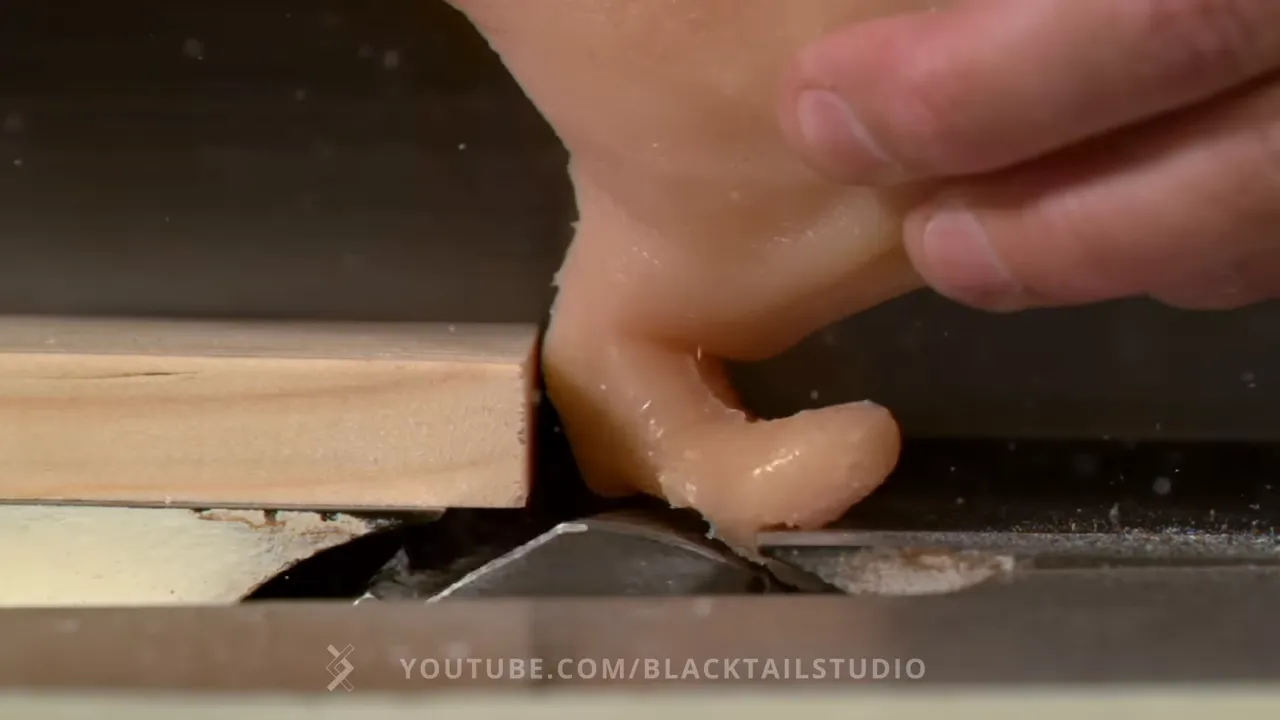
Our artificial-thumb test showed why the injury felt more like an impact than a tidy slice. The cutter chewed into the model, folded it backward, and pinched it against the jointer bed before shearing it away. It was not the clean cut I had imagined.
Kickback Can Put Your Fingers Where the Board Was
I also met someone who had lost the tips of four fingers in a jointer kickback accident. That was a failure mode I had not fully appreciated.
The board shoots backward, and the hand that was controlling it can move into the exposed cutter. We simulated that loss of support with another artificial hand and removed about half its thumb. Slowed down, it looked like a long sequence. At normal speed, it was over almost immediately.
Jonathan changed his shop's approach after his injury. Before using a machine, he now asks:
- Is this cut safe?
- Is there a safer way to accomplish it?
- Am I mentally present, or am I stressed, distracted, or tired?
If those questions do not get a clear green light, change the operation or come back later. That is a much better plan than hoping your attention catches up with your hands.
Router and CNC Injuries: Pause Does Not Necessarily Mean Stopped
Routers and CNC spindles put a carbide cutter on a motor spinning at thousands of revolutions per minute. In the setups we discussed, speeds were roughly 10,000 to 20,000 RPM. I could not find a useful combined injury figure for routers and CNC machines, but the hazard does not need a statistic to be worth respecting.
Chris Salomone of Foureyes Furniture learned that while flattening a slab on his CNC.
There was a clog, so he pressed pause. He assumed that would stop everything. It stopped the machine's movement, but not the spinning bit.
A brush cover hid the cutter. Chris reached in to clear the clog, could not quite get it, and moved his hand farther into a place it should not have been.
The bit tore off most of his thumbnail and cut underneath it. Fortunately, the nail grew back and he reported no permanent damage. He described the contact as a much nastier version of fingers bouncing against a household fan blade.
What Our Router Tests Showed
The router behaved differently from the jointer. With the bits and contact angles we tested, it removed the material presented to it without noticeably dragging the whole artificial hand farther in.
We tried several contacts, including a more forceful one. In one test, the gel smeared around the bit. The results were less dramatic than the jointer destruction, which is a strange thing to admit being disappointed about.
But less dramatic does not mean safe. These were specific tests with artificial materials, not proof that a router cannot cause an amputation or another severe injury.
The practical lesson is to verify that the cutter has stopped, rather than trusting what a pause button appears to mean. A dust brush can conceal a rotating bit just as effectively as it conceals the mess around it. Clearing a blockage calls for the machine's proper shutdown and isolation procedure, not a hand under the brush.
Chainsaw Injuries: Removing Material, Not Just Slicing It
The chainsaw is still the tool that scares me most personally. Every time I pick mine up, I would prefer not to become one of those injury estimates.
The artificial-leg tests made the cutting action painfully obvious. A chainsaw does not simply leave a narrow, neat slice. It aggressively removes whatever is in its path, including the gel and simulated bone in our models.
I also need to be honest about my own limitations: I had not received formal chainsaw training. Owning one and being comfortable starting it are not the same thing as knowing how to use it properly.
That is one reason I use protective equipment, including a helmet, face protection, and chainsaw chaps. PPE is not a replacement for skill, but it is a layer of protection I do not want to skip.
Do Chainsaw Chaps Actually Work?
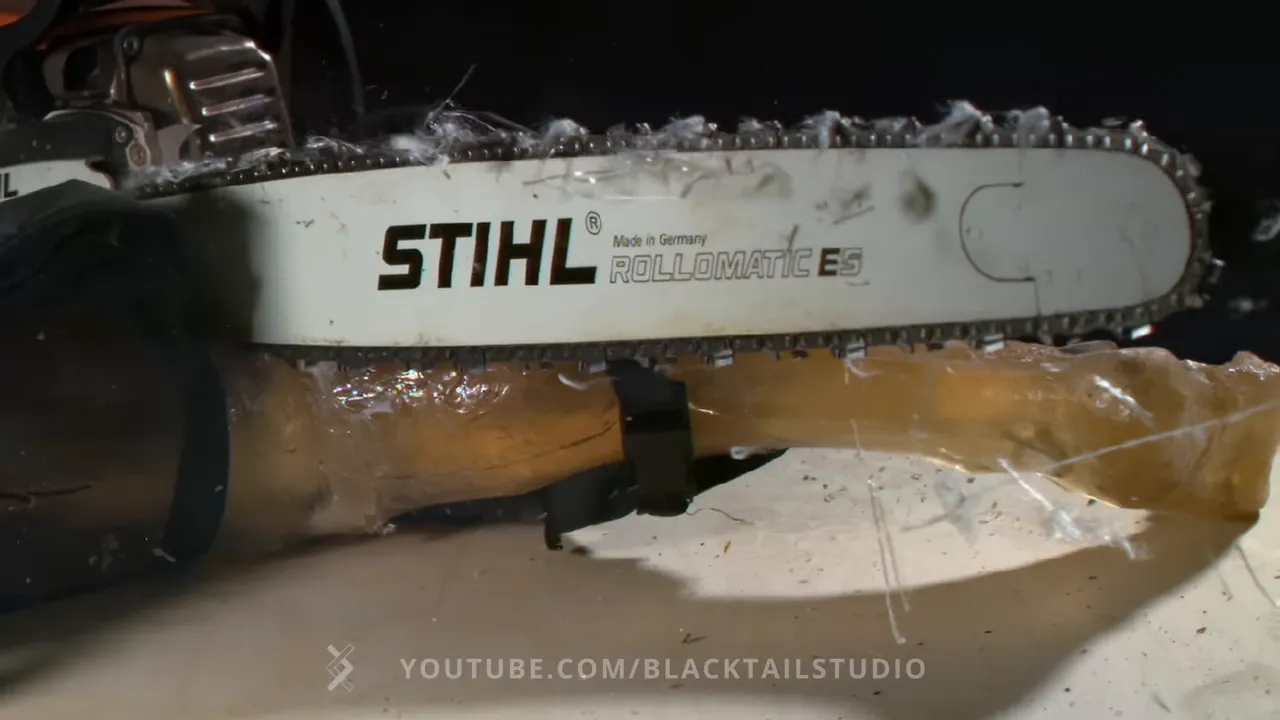
We put chaps around an artificial leg and tested whether they would stop the chain. The protective fibers pulled out and tangled in the cutting mechanism, stopping it. It looked like an annoying cleanup job for the saw and a very worthwhile trade for a leg.
There are two important details about that result:
- The model still received a small cut as the material wrapped around. How I fitted the chaps may have contributed.
- The artificial leg later separated, but it had already been damaged during shipping and cut twice in earlier tests. That separation was not evidence that the chain had cut through the protected leg.
I would not claim that chaps guarantee an injury-free outcome. I would say they looked very effective in this demonstration. The difference between the unprotected cuts and the protected test was substantial.
Nail Gun Accidents: Yes, a Framing Nailer Can Injure You
When I mentioned testing a framing nailer, some people questioned whether anyone actually shoots themselves with one. My former roommate Cameron Adams works in construction and had personally seen more than one example.
In one incident, a worker drove a nail through the web of his hand. In another, a man came down a ladder with his finger on the trigger and bumped the nailer against his thigh. The nail went so deep that its head was barely visible, and the X-ray showed it touching his femur.
Both stories included attempts to carry on working. That is part of what happened, not a recommendation for handling a puncture injury.
Our artificial-hand test showed the nail penetrating the model and striking the simulated bone. I am not going to pretend that recording it at 40,000 frames per second turned it into a major scientific breakthrough. Part of the appeal was that the high-speed result looked remarkable.
The accident mechanism Cameron described is the useful part: a finger on the trigger combined with unexpected contact can turn carrying the tool into firing it. The danger is not limited to the moment you intentionally drive a fastener.
For a more formal safety reference beyond these anecdotes, OSHA maintains resources on woodworking hazards and machine safety.
Angle Grinder Injuries: Why I Stopped Using Chainsaw Discs
An angle grinder is already a high-speed tool that deserves your attention. Add a chainsaw-style carving disc, and you have cutting teeth operating inches from your fingers.
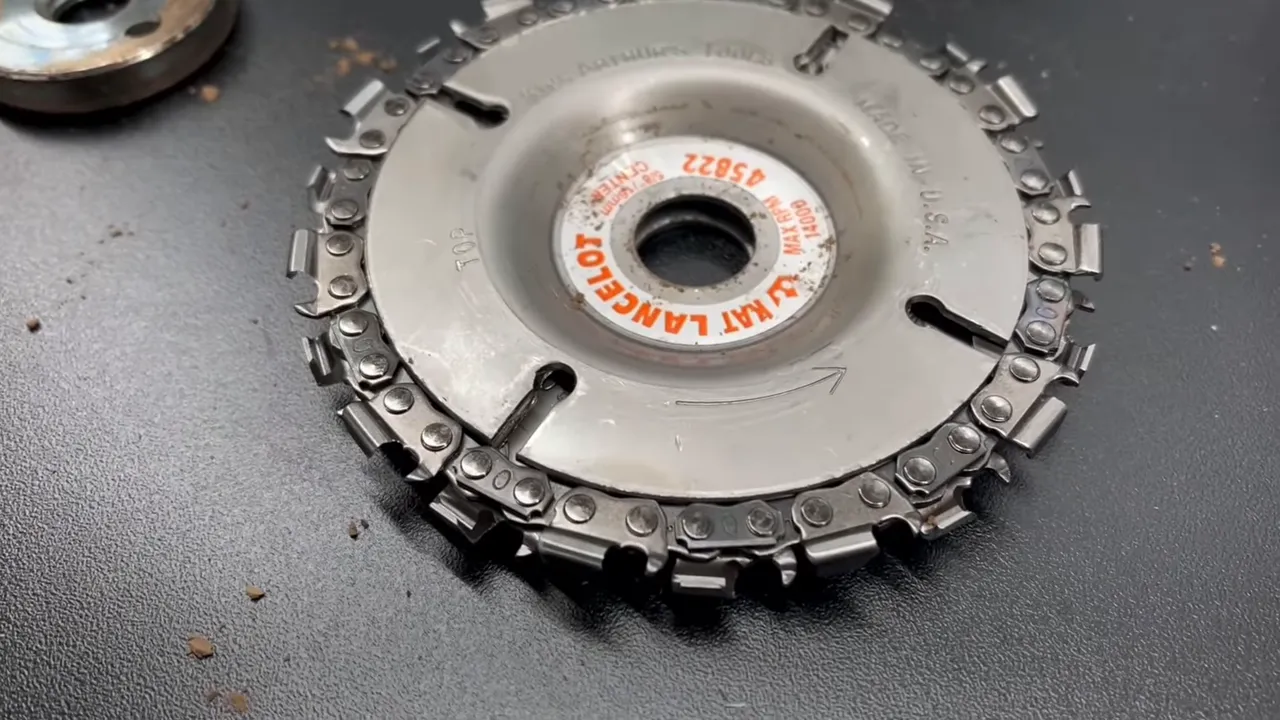
I contacted someone who had been badly injured by that specific attachment, but he declined to discuss it because of the criticism he received whenever he brought it up. That is unfortunate. Sharing an accident can help someone else avoid one.
John Malecki was willing to discuss an injury involving a different power-carving attachment: a Kutzall disc. Keeping that distinction straight matters. His accident was not caused by the chainsaw disc we tested.
A Breakthrough in the Workpiece Became a Loss of Control
John was carving the back of a chair from laminated plywood during a timed challenge. He was in a hurry. When he broke through the material, the grinder moved out of his control and struck the fleshy area beneath the little finger on his left hand.
He described the wound as torn and abraded, more like severe road rash than a clean incision. He believed a chainsaw-style cutting attachment could have produced a much worse result.
Our chainsaw-disc tests removed substantial amounts of gel and simulated bone. After using these attachments in the past, I have personally moved completely away from them. Nearly everyone I know who used them has done the same.
Move the Workpiece Instead of Contorting Yourself
John's advice was practical: do not let the grinder's manageable size convince you that every grip and working position is fine.
It is easy to start reaching around a workpiece or holding the tool at an awkward angle because the next area is only a few inches away. But when a high-speed attachment catches, a weak position gives you less ability to control what happens next.
Stop, reposition the workpiece, and return to a comfortable, strong working position. That is a much better adjustment than trying to finish the last little section while stretched around a corner.
Bandsaw Injuries: Off Is Not the Same as Stopped
The bandsaw often gets called the safest tool in the shop. Relative reputations are not much comfort when your hand touches the blade.
Meat-processing bandsaws cut through flesh and bone. A woodworking bandsaw's ability to cut wood should not leave anyone assuming their thumb presents much of an obstacle.
Our first test pushed an artificial thumb fully through the blade. Complete separation took roughly a tenth of a second.
I will acknowledge the limitation: deliberately feeding an entire model thumb through a blade is not the most representative everyday accident. The second test was much closer to a mistake I can imagine making.
The Blade Was Unpowered and Still Cut Deeply
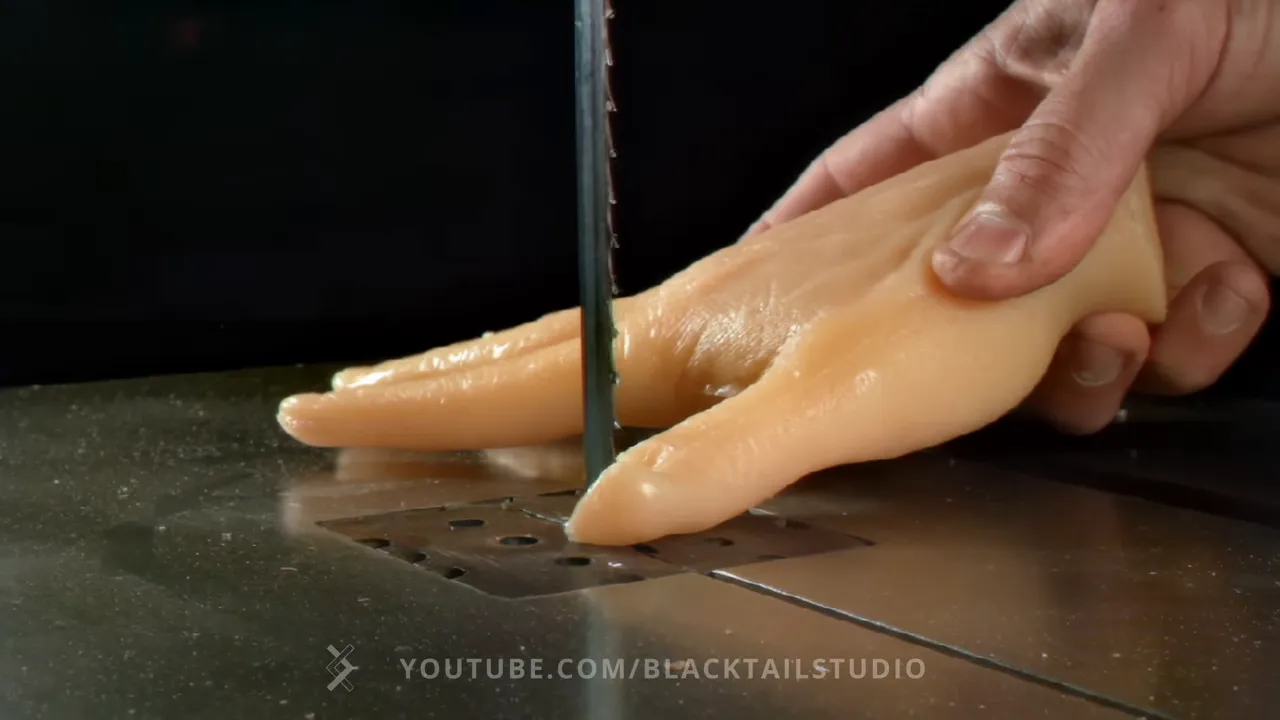
We brought the bandsaw up to speed, switched it off, and passed an artificial hand into the blade while it was coasting.
The brief contact cut roughly three-quarters of the way through the model thumb. The motor was no longer driving the saw, but the blade still had enough motion to do serious damage.
That is the version that really stuck with me. You finish a cut, hit the switch, and reach for your piece a moment too early. It does not require an elaborate chain of bad decisions.
Wait until the blade is completely stationary before reaching near it. My visual reminder is to wait until the individual teeth are clearly distinguishable and motionless, rather than treating the switch position as proof that the danger has passed.
Table Saw Injuries: A Shortcut That Worked Until It Did Not
The table saw produced some of the most disturbing results of the entire project. The blade did not simply pass through the artificial hand. It caught and redirected parts of it, causing extensive damage in a split second.
Jimmy DiResta shared a real accident that shows how blade contact can be the final event in a much larger chain.
Jimmy DiResta's Kickback Accident
In March 2010, Jimmy was cutting a rabbet in a roughly 48-inch-long 1-by-3 bullnose piece. He had made one cut, flipped the board, and was raising the running blade into the wood for the second part of the rabbet.
It was a shortcut he had performed many times before. This time, the blade caught the board and threw it.
The wood hit the forearm he had near the blade-height adjustment. He lurched forward, and his other hand landed on the spinning blade. He felt it pull his hand downward, but his attention was initially on the blow to his forearm.
When he looked at his hand, his little finger was lying in his palm. Surgeons reattached it, but he said it never regained normal function beyond the injury.
The lesson is not simply to avoid putting a hand on a blade. Jimmy did not set out to do that. The unsafe setup caused kickback, the kickback disrupted his balance, and that movement brought his hand into contact.
He stopped using that shortcut after the accident and changed his approach to safety equipment and practices. A method working a hundred times is not proof that it is safe the next time.
Why the SawStop Logo Did Not Mean the Brake Was Active
The saw used for our demonstrations was a SawStop, but I deliberately disabled its flesh-sensing braking feature for most of the tests. The destruction shown in those tests was not the result of an active brake failing.
There was one accidental exception. I forgot to disable the feature for one artificial-arm test.
The ballistic gel itself did not trigger the system. The blade cut into it until it reached the conductive wire holding the simulated bones together. Contact with that wire triggered the brake, which cost me a blade and a cartridge.
That distinction matters: this was not a clean demonstration of the system detecting human skin. It was an unexpected activation caused by a conductive component inside an artificial model.
Not Every Table Saw Accident Starts With a Cut
Before woodworking became my full-time job, I flew medical helicopters for Life Flight. One of my earliest flights was to pick up a man whose dog had jumped on him, causing him to fall onto a running table saw and land on his forearm.
That memory gave the artificial-arm demonstrations a very different weight for me. The danger is not limited to feeding a board incorrectly. A surprise, a loss of balance, or something happening beside the machine can put you into the blade.
My enthusiasm for injury-mitigation technology is not sponsored. One ambulance ride or emergency-room visit puts the cost of safer equipment into perspective very quickly. But technology belongs alongside safe working practices, not in place of them.
The Most Important Result Was the Same for Every Tool
At 40,000 frames per second, every accident becomes a sequence you can study. At normal speed, most are little more than a movement and an immediate result.
That is what I want to carry back into the shop. Not a competition over which machine is scariest, and definitely not confidence that I could pull away fast enough.
The recurring lessons were straightforward:
- Check your mental state. Stress, fatigue, and deadlines showed up in the real accident stories.
- Question familiar shortcuts. Repetition can make an unsafe operation feel normal.
- Verify that cutting parts have stopped. Paused, switched off, and stationary are different conditions.
- Fix the setup before continuing. Reposition awkward work instead of compromising your control.
- Use appropriate protection. The chaps test showed how a protective layer can change an outcome without making the tool harmless.
These machines are very good at removing material. The goal is to make sure your body never becomes part of the job.
A Separate Kind of Protection: The Finished Table
Once the tools are off and the furniture is finished, I have another ongoing safety dispute at home: coasters. My wife loves entertaining and is considerably less enthusiastic about asking guests to put something underneath their drinks.
That was the less terrifying motivation behind our N3 Nano coating, an invisible protective layer for finished wood surfaces. I tested it with beer, wine, lemon juice, hot sauce, and other common spills. It is intended to add surface protection over a wood finish, rather than replace the finishing process.
Protecting a table is obviously not in the same category as protecting a hand. But after putting all that work into a piece of furniture, I would like it to survive dinner, too.
|


