A detective from the Davenport, Iowa, Police Department contacted me about a woman who had paid roughly $17,000 for a Blacktail Studio table and received absolutely nothing.
There was one fairly important detail: she hadn’t ordered it from me.
Someone had copied my website, added an extra “s” to the address, and used that convincing imitation to take her money. We were able to get the fake website taken down. Getting her money back was another matter.
I couldn’t fix that part. But I could build her the table she had tried to order. And while I was doing that, I figured I could learn a little more about the people impersonating me and make at least one of their workdays significantly less productive.
A Fake Website and a Real Dream Table
The fake site wasn’t some vaguely suspicious page with three blurry furniture pictures. It mirrored my actual website. The address was BlacktailStudios.com rather than BlacktailStudio.com, an easy difference to miss when everything else looked familiar.
The detective needed to establish that I wasn’t involved, let me know what was happening, and gather the information required for his investigation. Once we had sorted that out, he didn’t ask me for anything else.
But I kept thinking about the woman in Iowa. Her name is Teresa, and she hadn’t just lost money. She had picked out a specific table, worked through the details, and expected something beautiful to arrive.
If I was going to surprise her, I wanted to build her dream table, not whatever I happened to feel like making. Normally, that starts with a customer call. A surprise makes that slightly difficult.
So I recruited an inside man: the detective.
He volunteered his own time, went back through Teresa’s messages with the scammer, and found exactly what I needed: reference photos, dimensions, and even the legs she had requested.
Nick at Maverick Sawmill helped with the other essential ingredient. When I explained the project, he offered the walnut slabs for free. I would like to say he had to twist my arm, but he offered once and I immediately accepted.
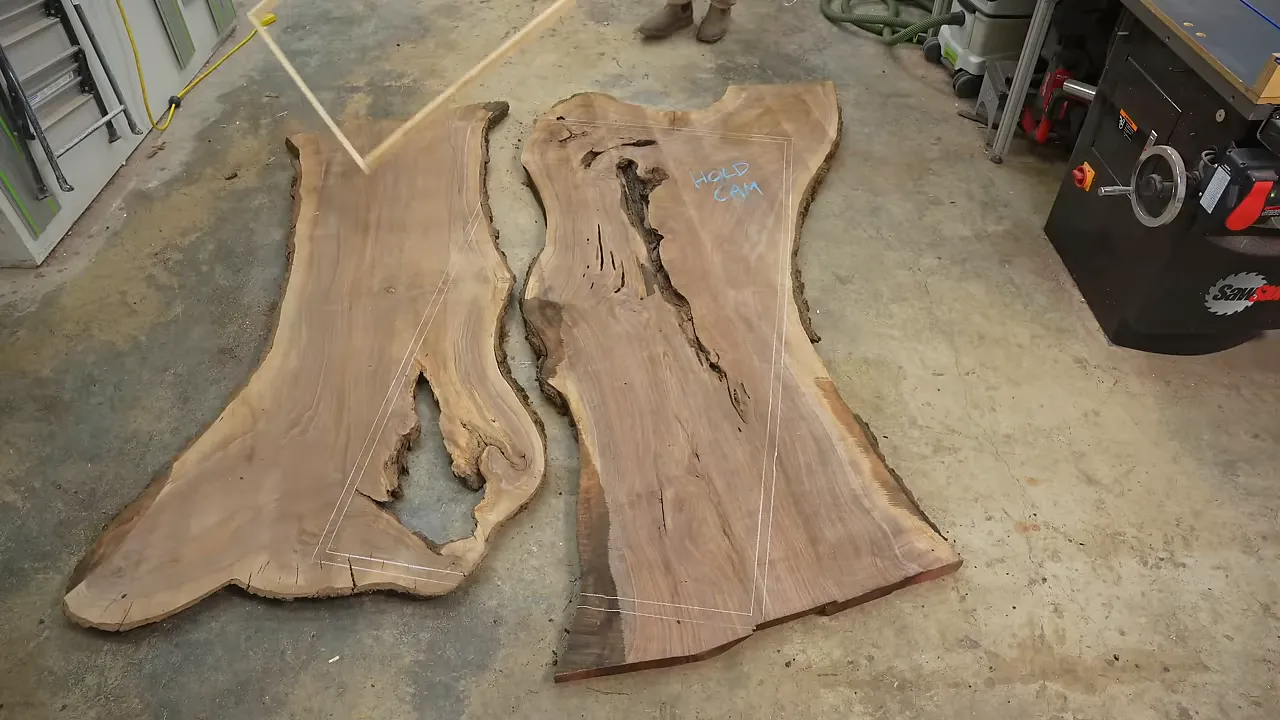
The initial work was familiar: lay out the slabs, establish the shape of the top, and remove bark and loose material from the live edges and voids. Those interesting natural edges are worth preserving, but the material that stays needs to be sound.
The Blue Epoxy Argument I Lost
I love black epoxy with walnut. I think it is the best combination, and I’m not especially interested in pretending that opinion is up for debate.
Unfortunately, Teresa wanted blue.
I’m embarrassed to admit that I nearly made the table black anyway. Then Scott pointed out that I had supposedly committed to building her dream table, not mine.
It was one of those irritating moments when someone makes a perfectly reasonable point and ruins your argument.
So I got the metallic blue pigment.
Why metallic pigment needed so much attention
My usual black color comes from a liquid dye that dissolves into the epoxy. The metallic blue powder behaves differently. Its particles remain suspended in the resin and can settle as the epoxy cures.
That meant pouring the table wasn’t the end of the job. It was the beginning of a very long relationship with a stirring stick.
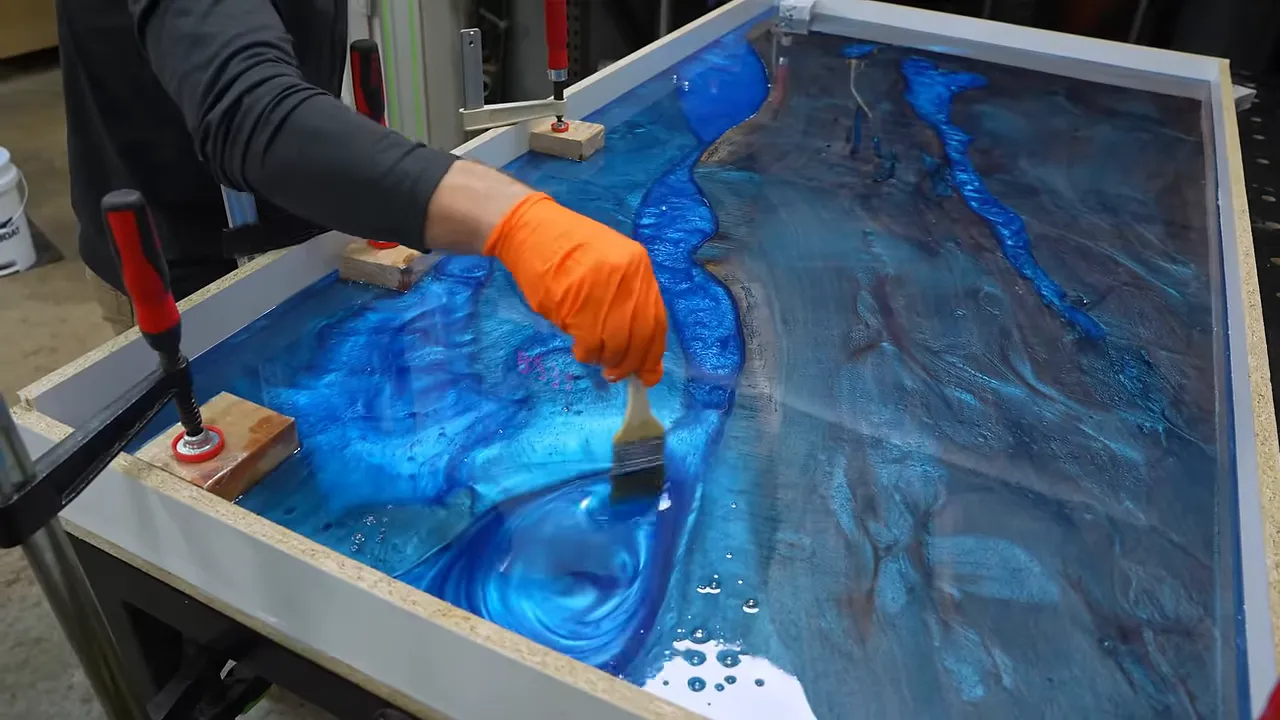
I got up at 5 a.m. to make sure the epoxy hadn’t cured beyond the point where I could work it. Then I kept coming back every 30 to 40 minutes throughout the day to stir it again.
I also monitored the temperature. During this pour, it climbed a little above the roughly 130°F point I was trying to avoid, so I brought in a fan and continued checking it for another two or three hours. The temperature came down, and the top cured nicely.
Those temperatures and intervals describe this particular pour, not a universal epoxy recipe. Resin choice, pour depth, and curing conditions matter. The important lesson is that metallic pigment and curing heat both deserve attention before you walk away from a large pour.
Meeting the Other “Me”
While the table was progressing, I started researching scambaiting: deliberately occupying scammers so they spend their time on someone who isn’t going to pay them.
Kitboga and Scammer Payback have turned that into an art form. I reached out to several people in that world without much luck, although I did connect with someone involved in O2’s AI Granny, a system designed to keep scam callers busy with an exceptionally patient artificial grandmother.
He was supportive and offered to help, including the possibility of using my voice. But the scammers impersonating me had no interest in talking to me. They didn’t seem particularly interested in phone calls at all. They wanted direct messages.
Finding one was depressingly easy. Within seconds on Facebook, I found an account replying to someone’s comment, claiming they had won a prize and directing them to Telegram.
This happens constantly. People email me asking whether they really won something. Usually, the impersonator claims to be Blacktail Studio and says the prize is free as long as the recipient pays shipping. It has become common enough that my website’s contact page is largely a scam warning.
An unexpected prize message followed by a request to move to Telegram or WhatsApp is a major warning sign. Neither app automatically makes a conversation fraudulent, but a familiar profile picture does not establish who is behind the account.
I created a generic identity, Jim Thompson, hid my phone number from public display, and contacted the fake Blacktail Studio account. I said my wife had been told she won a prize and asked whether the offer was still valid.
In an astonishing development, it was.
Apparently, she had won a MacBook, a hoodie, and two limited-edition stickers. All we needed to do was pay about $200 for shipping.
A $9,000 Table and an AI Video of My Face
I wanted to see whether the prize scam would turn into a furniture scam, so Jim asked about commissioning a table.
The fake me was very available.
I requested a 10-foot epoxy dining table and asked what width he recommended. He suggested one meter. That was a little out of character for my usual measurements, though hardly proof of where someone was located.
We settled on a $9,000 price, and he became very interested in collecting a $5,000 deposit immediately.
I played confused. He responded with something I genuinely wasn’t prepared for: a video of “me” assuring Jim that I was real, definitely not a scammer, and delighted about his prize.
It was an AI-generated impersonation. My eyes looked strange, my beard seemed to change as I spoke, and the dialogue sounded like someone had assigned a child to write a convincing statement about not committing fraud.
But it was still unsettlingly good.
The practical lesson is bigger than whether this particular fake had obvious flaws. A personalized video is no longer reliable proof of identity by itself. If money is involved, verify the person or business through contact information you locate independently, rather than through the account asking for payment.
The FTC’s guidance on avoiding scams is a useful reference for recognizing payment pressure and checking suspicious requests.
The American payment account belonged to another victim
Next, the scammer sent bank details, a bank address, an email address, and PayPal information associated with someone in the United States.
I thought I finally had something useful. Maybe this was a domestic operation, or at least someone we could identify.
A friend at the Portland Police Department warned me not to jump to that conclusion. The person attached to the account might be another victim.
That is exactly what happened.
I found the real account holder, whom I’ll call Todd, and alerted him. His identity and PayPal account were being used without his knowledge to help move money to scammers.
A normal-looking name and a domestic account had made the payment instructions seem more credible. They did not prove that the person named was the person committing the crime.
That also sent me down the unpleasant rabbit hole of how readily personal information can be found through people-search sites and data brokers. Data-removal services can help handle removal requests, but the immediate issue here was securing a compromised payment account.
Building Wooden Legs That Were Supposed to Be Metal
Teresa’s reference photo showed metal legs. I decided to recreate the general idea in walnut, with an interlocking feature that would make the base a little more interesting.
Yes, after Scott convinced me to respect her epoxy preference, I took some creative liberties with the legs. My defense is that the wooden version was going to be cool. Assuming I could figure out how to build it.
The plan involved eight angled pieces with notches that would allow them to intersect. Scott and I worked through the geometry, including a 26-degree setup, and developed a spacer arrangement to establish the notch width.
It made perfect sense right up until we tried fitting the pieces together.
They did not fit.
The wrong side of the blade matters
The mistake was simple: I had measured to the wrong side of the dado blade stack.
I needed to reference the cutting edge closest to the fence, but I had measured to the far side. With a 5/8-inch-wide dado stack, that was not a rounding error.
Once I understood it, the correction was to make the spacer 5/8 inch thinner and repeat the setup using the correct reference.
I also had to replace one leg. Naturally, I hadn’t cut a spare. Rather than recreate every original miter-saw setting for a single piece, I copied one of the good legs and used that to make the replacement.
Two lessons came out of that:
- Check the actual cutting edge you are measuring from. Blade width is part of the setup.
- Make spare parts for complicated repeated assemblies. One extra blank would have saved me a detour.
After the remaining notches were cut, we assembled the pieces and discovered something else. Instead of the two intersecting V shapes I had imagined, they made a crisscross pattern resembling a Celtic knot.
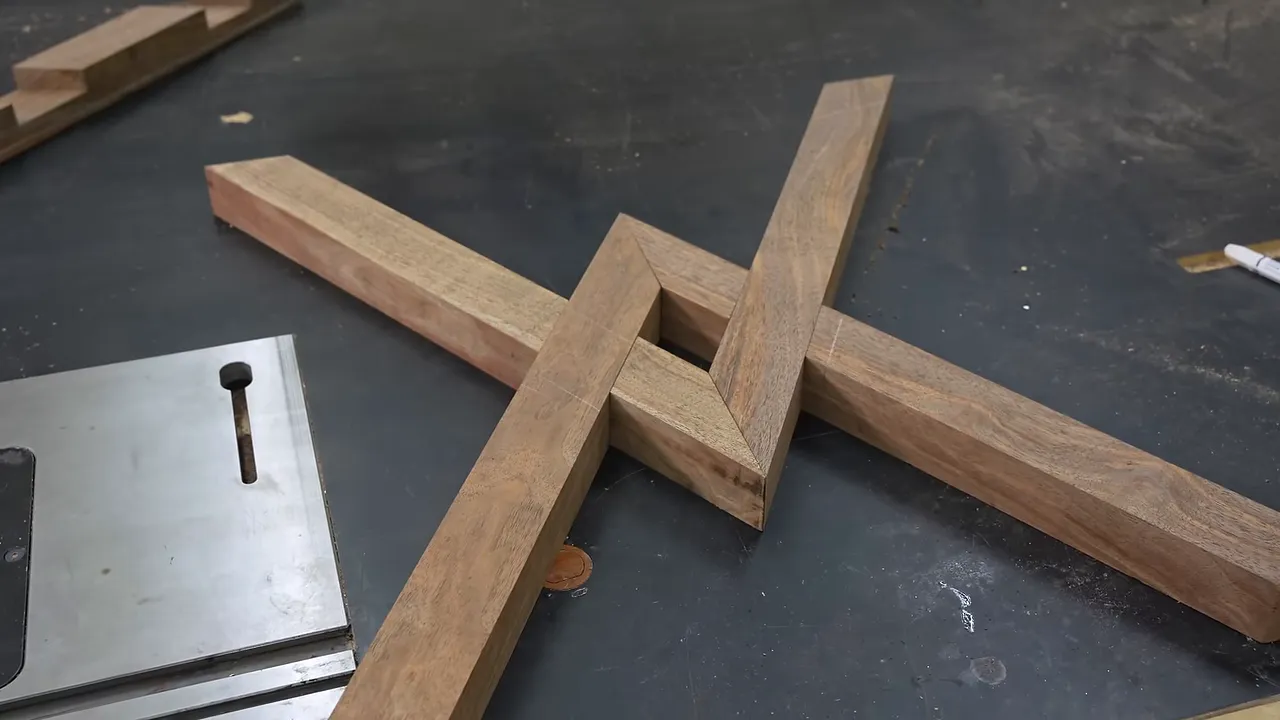
I would love to take credit for designing it that way. I cannot.
Two Payments I Never Made
Meanwhile, Jim was having trouble following the scammer’s international transfer instructions. This was mostly because Jim was me and I had no intention of following them.
Eventually, I said I lived about an hour away and could simply drop off the deposit.
The scammer strongly preferred that I not do that.
So I told him I had already left $5,000 in his mailbox. He panicked and told me to retrieve it. I then invented an encounter with his wife, who, in this ridiculous scenario, was my actual wife, and said she was threatening to call the police.
He told me to give her the money. I asked whether that meant he had my deposit.
He said yes.
To be clear, no money went into anyone’s mailbox. But I had managed to get a scammer to acknowledge receiving a payment that didn’t exist, which felt like a modest professional achievement.
About 36 hours later, he wanted more money.
I asked for progress pictures first. Out of all my furniture projects he could have stolen images from, he chose pictures from a staircase build. Nothing reassures a dining-table customer quite like evidence that their table is becoming stair treads.
Then came a personal story about problems with his wife and an urgent need for another $3,000.
Scott made fake payment screenshots, which I sent as part of the bait. At the same time, I contacted the real owner of the PayPal account being used and helped get him to change his password, log out other devices, and check the account’s withdrawal access.
Locked out of that account, the scammer couldn’t check it himself. After arguing about the screenshots, he eventually acknowledged receiving the second nonexistent payment.
That left $1,000 on our imaginary balance. Predictably, he wanted that too.
I told him I was sending it to his “manager,” meaning the account he could no longer access, and left the conversation. By that evening, I had 12 messages waiting.
Clamp Dents, Steam, and One Terrible Sanding Invention
The leg glue-up went reasonably well, apart from two mistakes that became extremely obvious afterward.
First, I should have sanded the interior surfaces before assembly. Once everything interlocked, the narrow openings were difficult to reach with any of my sanders.
Second, a clamp placed across the middle left sharp dents in the wood.
The dents weren’t going to disappear with a quick sanding pass. So I tried a repair I had seen plenty of times but never used myself: water, a wet cloth, and an iron.
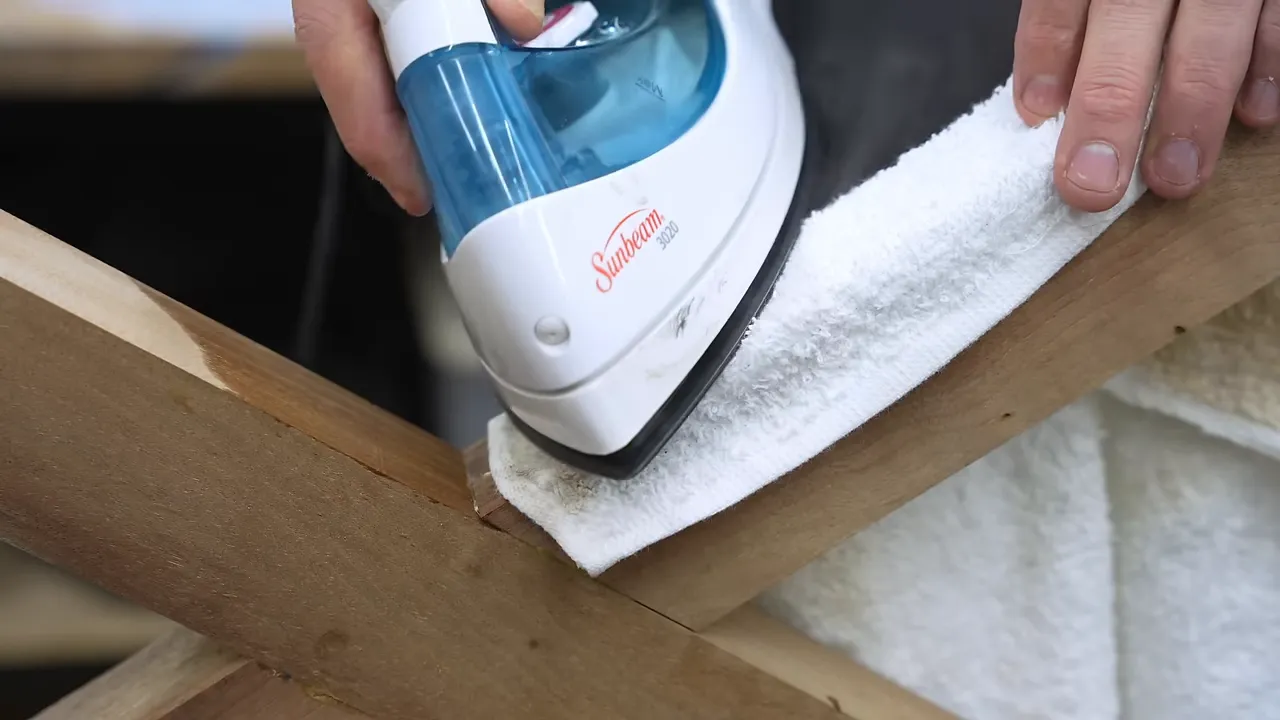
I wet the affected area, laid the damp cloth over it, and applied the iron. The first dent came up beautifully.
The second initially looked worse, but the compressed area had actually risen slightly above the surrounding surface. Once it was proud rather than recessed, the sander could level it.
The inaccessible interior corners were another story. I tried every sander that looked even remotely promising. None fit.
Then I had a brilliant idea: grind the teeth off an oscillating-tool blade, attach sandpaper, and create the sanding tool the woodworking world had somehow failed to invent.
I was proud of that for several seconds, right up until it damaged the wood.
So the revolutionary new method was abandoned in favor of painstaking hand sanding, with small tools and abrasives worked into the tight spaces. Pre-sanding would have been considerably less exciting and considerably smarter.
Finishing the Table and Thinking About Its Care
With the base sorted out, the top still needed the less glamorous work that separates a cured epoxy slab from a finished table: flattening, cleaning out small remaining defects, filling voids, scraping, sanding, and refining the edges.
The blue river and walnut figure became much more convincing as the surface preparation progressed. I still love black epoxy, but this was making a pretty good argument for occasionally listening to someone else.
I also think about maintenance before furniture leaves the shop. My usual advice is to avoid grabbing a random commercial wood polish simply because the label promises shine. Products that leave waxy buildup or don’t suit the finish can create problems later.
For routine care, I generally recommend a cloth lightly dampened with water rather than saturating the surface. Follow the care instructions for the finish on your particular piece.
I had also been working with a European company on a cleaner intended specifically for wood furniture without the problems I disliked in conventional products. That project became N Zero Wood Cleaner.
What Scambaiting Accomplished, and What It Didn’t
I considered ending the conversation with a big reveal: surprise, you have been trying to scam the actual person you’re impersonating.
But I figured he would delete the conversation, change accounts, and disappear. Keeping Jim alive meant I could keep the conversation going with confused messages, supposed payment mistakes, and the occasional rambling attempt to make a new friend.
I created the DIY Scambaiting community as a place to discuss these experiences and share information. The conversation itself is available in part one and part two.
My thinking was simple: time spent dealing with Jim was time not spent convincing someone like Teresa to send money.
That is the hope, not a measured result. I didn’t recover Teresa’s money or dismantle an international operation. What I did accomplish was alert an account holder, help interrupt access to a compromised account, expose some of the tactics, and occupy a scammer.
Protecting yourself matters more than getting a funny exchange. A generic name and a hidden phone number are not a complete privacy plan. Don’t send money, identity documents, account credentials, or personal information to keep a conversation going. If you receive a suspicious message, independently verify it and report it. You do not need to engage.
Getting the Table to Iowa Without Accidentally Losing It
The generosity around this project kept surprising me. The detective arranged for Old Dominion to ship the table at no charge.
They showed up and took the crate. I did not have nearly as much paperwork or contact information as a sensible person probably would have wanted before handing over a finished table.
Then Scott and I headed to Iowa.
During the three-hour drive to Davenport, Scott began asking reasonable questions. Did I know Teresa’s age? Her name? Whether we had permission to film at the police station? Where the table had actually been delivered?
My answers did not inspire confidence.
There was also the small issue that I had been texting with an officer I knew as Dave, but hadn’t been able to find him online. When we arrived at the department and initially got a confused response about the name, it briefly felt possible that I had built an entire table for a scam about a scam.
Fortunately, the officer was real. His name was Gordon, or Gordo, which explained why my earlier search hadn’t helped.
He arranged the introduction with Teresa. We showed her the AI impersonation clip, then explained that she was meeting the actual person behind the face.
The department’s footage of that first meeting was accidentally deleted. Fortunately, we still had the moment that mattered most: introducing Teresa to her table.
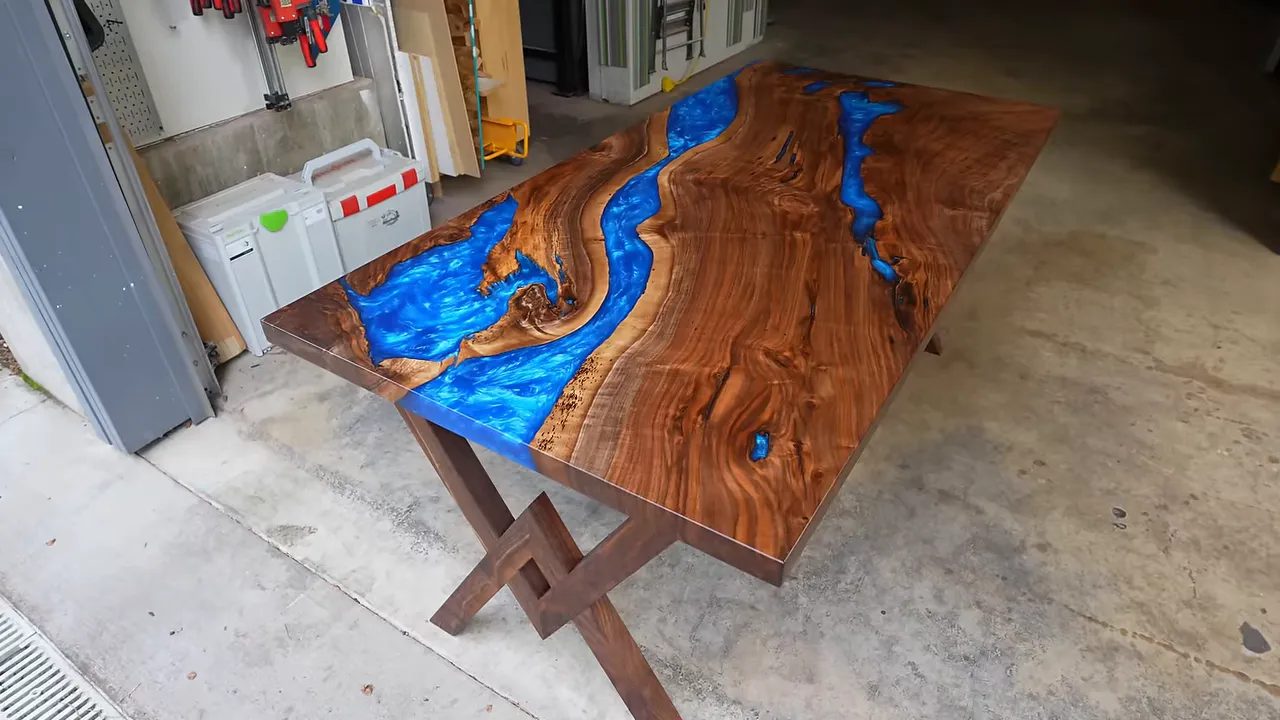
She had expected another conversation about money that couldn’t be recovered. She had not expected the table she had tried to buy.
She was overwhelmed, grateful, and trying not to cry. I was trying to maintain my usual cold, calculated exterior, which was not going particularly well either.
The table didn’t replace the money or undo what happened. But it gave her something real at the end of an experience built entirely on deception.
The Scammer Found the Finished Table, Too
After the delivery, Teresa posted a Facebook photo of the three of us with the table.
Shortly afterward, the scammer I had been messaging sent me that same photo and claimed it showed the table he had built for Jim.
That was strong evidence connecting my conversation to the person or people who had scammed Teresa. Of all the supposed progress pictures he could send, he had found a newly posted photo from the very woman whose table started this project.
Apparently, building the table, delivering it to Iowa, and standing beside its owner still wasn’t enough to stop someone else from taking credit for it.
I didn’t get to hand Teresa her money back. I did get to hand her a table. And for once, the guy pretending to be me had a real customer who was never, ever going to pay.


